
Union Budget 2026 vs 2025: The Biggest Shifts You Shouldn’t Miss
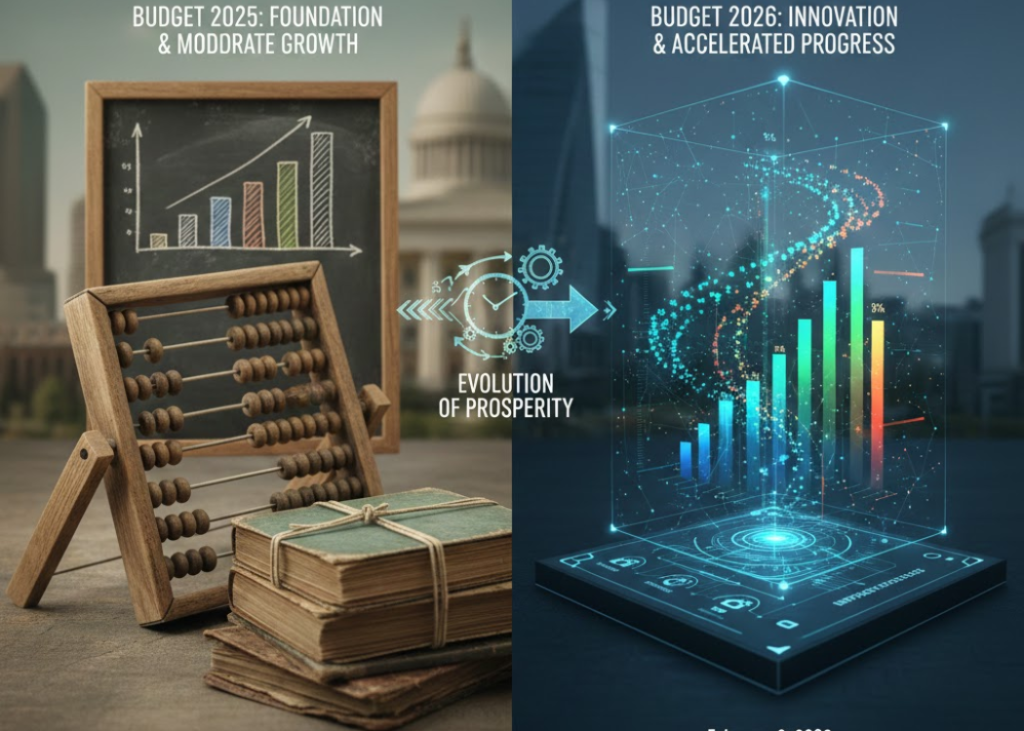
The Union Budget is India’s most important financial statement, outlining government priorities, spending plans, taxation policy, and structural reforms. The Budget 2026–27, presented and passed in Parliament on 1 February 2026, builds on the framework of Union Budget 2025–26 and sets new targets for growth, fiscal discipline, and sectoral development. In this article, we compare the Union Budget 2026 vs Budget 2025 highlights how India’s fiscal strategy is evolving from broad-based support to targeted, technology-driven growth. 1. Fiscal Targets & Expenditure Budget 2025–26 Budget 2026–27 Interpretation:The government is increasing spending to boost economic growth while maintaining fiscal responsibility. This balance is essential for long-term stability. 2. Taxation & Compliance Budget 2025 Highlights Budget 2026 Changes Impact: 3. Infrastructure & Transport Budget 2025 Budget 2026 Effect: 4. Defence & Security Budget 2025 Budget 2026 Significance: 5. Agriculture & Rural Development Budget 2025 Budget 2026 Effect: 6. Healthcare Budget 2025 Budget 2026 Impact: 7. Education & Skill Development Budget 2025 Budget 2026 Effect: 8. MSMEs, Industry & Services Budget 2025 Budget 2026 Impact: 9. Energy, Environment & Technology Budget 2025 Budget 2026 Effect: 10. Social Welfare & Inclusive Growth Budget 2025 Budget 2026 Impact: Comparison Table: Budget 2025 Vs 2026 (Sector Wise) Sector Budget 2025–26 Budget 2026–27 Fiscal Deficit 4.4% of GDP 4.3% of GDP Total Expenditure ₹50.65 lakh crore ₹53.5 lakh crore Capital Expenditure ₹11.21 lakh crore ₹12.2 lakh crore Defence ₹4.91 lakh crore ₹5.94–7.84 lakh crore Transport & Infrastructure Major roads & rail funding ₹5.98 lakh crore + high-speed rail & waterways Agriculture & Rural ₹1.71 lakh crore ₹1.62 lakh crore + ₹95,692 crore VB‑GRAM Healthcare ₹98,311 crore ₹1.06 lakh crore + mental health & cancer focus Education & Skills ₹1.28 lakh crore AVGC labs, National Institutes of Design, STEM & girls’ hostels MSMEs & Industry Credit support & digital push ₹10,000 crore growth fund, exports & electronics support Energy & Technology Renewable, urban projects Battery storage, semiconductors, green tech Social Welfare Urban & rural schemes Expanded employment, housing, women-focused programs Read This For detailed information :- Indian Union budget 2026: Key Highlights Of All Sectors. Conclusion This Union Budget 2025 vs 2026 comparison shows India’s shift from broad fiscal support toward targeted, sector-driven growth. While Budget 2025 focused on general relief measures, infrastructure expansion, and welfare support, Budget 2026 takes a more strategic approach, emphasizing technology adoption, skill development, and inclusive growth. Key highlights include record capital expenditure, stronger allocations for healthcare and education, enhanced support for MSMEs and rural development, and a clear push for green energy and modern infrastructure. Overall, Budget 2026 reflects a balanced approach, combining economic growth, fiscal prudence, and social welfare, setting the stage for a resilient and competitive India in the years ahead.
Indian Union budget 2026: Key Highlights Of All Sectors.

The Indian Union Budget 2026–27, presented and passed on 1 February 2026, sets the economic direction for India at a time of steady growth and global uncertainty. Budget 2026 focuses on long-term development through infrastructure expansion, simplified taxation, manufacturing growth, and targeted support for key sectors.The budget balances fiscal discipline with development needs, aiming to strengthen domestic demand, boost employment, and attract sustained private investment. India’s nominal GDP for FY27 is estimated at ₹354 lakh crore, providing the base for fiscal planning. 1) Economic Priorities and Fiscal Strategy Focus on Growth with Fiscal Discipline Budget 2026 continues the government’s approach of supporting economic growth while keeping public finances under control. The total government expenditure has been set at ₹53.47 lakh crore, reflecting a strategic expansion in development and social expenditure. This includes substantial outlays for infrastructure, rural development, and human capital formation. The budgetary framework emphasises sustained growth while containing pressures on inflation, pushing for structural reforms that bolster investment and enhance productivity. Higher Capital Expenditure for Long-Term Returns Capital expenditure has been increased to ₹12.2 lakh crore, the highest ever aimed at supporting infrastructure projects with high economic multipliers. This includes transport, logistics, water resources, digital infrastructure, and urban development. Key focus areas include: Gradual Reduction in Fiscal Deficit The fiscal deficit target for FY27 has been projected at 4.3% of GDP, improving from FY26’s estimate of 4.4%. This reflects a cautious yet proactive fiscal consolidation pathway while supporting growth. Borrowing strategies are structured to increase capital expenditure while moderating revenue deficits, with a focus on long-term investment. 2) Taxation and Compliance Changes Implementation of the New Income Tax Act Budget 2026 formally brings into effect a simplified Income Tax Act, effective from April 2026. This aims to reduce the number of sections and procedural complexity, increase digital compliance, and substantially reduce litigation. The new framework consolidates and rationalises over 536 provisions into a more transparent structure. Relief for Overseas Education and Medical Expenses Tax Collected at Source (TCS) on remittances for foreign education and medical expenses has been reduced to 2%, down from the previous 5%, easing liquidity for families and students. Changes Affecting Financial Markets 3) Infrastructure and Capital Investment Expansion of Road and Rail Networks Massive infrastructure spends continue: High-Speed Rail and Water Transport Seven new high-speed rail corridors have been announced to strengthen regional connectivity and promote city-to-city economic integration.Operationalisation of 20 new national waterways and coastal cargo promotion schemes aim to boost multimodal freight movement and cut logistics costs. Urban Infrastructure and Metro Projects Urban development receives substantial funding for metro expansions in Tier-2 and Tier-3 cities, sanitation, water supply, housing and smart city upgrades to improve livability and future job creation. 4) Manufacturing and Industrial Growth Boost to Electronics and Semiconductor Manufacturing The Budget strengthens strategic electronics and semiconductor programmes: Support for Strategic and Heavy Industries Dedicated funds for container manufacturing (₹10,000 crore) as well as chemical parks and industrial clusters aim to reduce imports and improve export competitiveness. Industrial Infrastructure & Clusters Incentives for logistics zones, corporate participation in industrial parks, and risk guarantee funds are designed to attract ₹6–8 lakh crore in private investment over the next five years. 5) MSME and Startup Support Creation of MSME Growth Fund A ₹10,000 crore SME Growth Fund has been set up to develop high-potential small and medium enterprises into global champions with equity support. Improved Credit and Compliance Support Support for Startups and Innovation An additional ₹2,000 crore top-up to the Self-Reliant India Fund supports risk capital for startups, particularly in deep tech and manufacturing innovation. 6) Agriculture and Rural Economy Strengthening Farm Infrastructure Agriculture and allied sectors have been allocated around ₹1.62 lakh crore, supporting irrigation, rural roads, soil health and market linkages, aiming to diversify rural incomes. Support for Storage and Supply Chains Cold storages and warehousing infrastructure receive increased allocations to reduce post-harvest losses and ensure better farm price realisation, enhancing food security and farmer incomes. Focus on Sustainable and Digital Farming Natural farming programmes, water-conservation initiatives and expanded digital platforms are being scaled across hundreds of districts to improve resilience and yield forecasting. 7) Healthcare and Social Welfare Expansion of Healthcare Infrastructure Healthcare spending rises to ₹1,06,530 crore, with focused expansions in medical colleges, diagnostic networks, hospital capacity, and rural health infrastructure. Investment in Biopharma and Research The Biopharma Shakti initiative with ₹10,000 crore over five years focuses on vaccines, biosimilars and advanced therapies with global export potential. Continued Social Welfare Support Comprehensive funding for pensions, housing support, nutrition programmes and women-focused schemes remains robust, supporting inclusion and economic security. 8) Education, Skills, and Employment Strengthening Education Infrastructure Education sector expenditure is now around ₹1.39 lakh crore, supporting digital classrooms, higher education expansion, research funding, and skill enhancement initiatives. Key initiatives include linking education with employment opportunities, establishing new design and research institutions, developing university townships near industrial corridors, and building gender-inclusive infrastructure. Skill Development for Future Jobs Skill development outlays have increased significantly (₹22,000+ crore), training youth in logistics, advanced manufacturing, AI/technology and green jobs. Support for Youth and Innovation Innovation hubs, AVGC labs in schools and expanded R&D funding support entrepreneurial culture and high-value job creation. 9) Defence and Strategic Spending Increased Defence Allocation Defence spending has increased to approximately ₹7.85 lakh crore, an uplift to modernise forces, boost equipment procurement, and build technological edge. Significant capital outlay (₹2.19 lakh crore) supports aircraft, naval assets and domestic production under ‘Make in India’ defence policies. Push for Domestic Defence Manufacturing 10) Technology, Digital Economy, and Innovation Support for Advanced Technologies Advanced technology research in AI, semiconductors, aerospace, and deep tech receives dedicated funding (₹18,000+ crore), strengthening India’s position in future industries. Expansion of Digital Public Infrastructure Digital public platforms receive ₹15,000 crore to enhance governance efficiency, financial inclusion and service delivery across rural and urban regions. Budget 2025 vs Budget 2026 Comparison Category Budget 2025 Budget 2026 Total Expenditure ₹48.2 lakh crore ₹53.47 lakh crore Capital Expenditure ₹10.96 lakh crore ₹12.2 lakh crore Fiscal Deficit 4.4% of